| |
|


- Morn in the wake of the morning star
- Came furrowing all the orient into gold.
- We rose, and each by other drest with care
- Descended to the court that lay three parts
- In shadow, but the Muses' heads were touched
- Above the darkness from their native East.
- There while we stood beside the fount, and watched
- Or seemed to watch the dancing bubble, approached
- Melissa, tinged with wan from lack of sleep,
- Or grief, and glowing round her dewy eyes
- The circled Iris of a night of tears;
- 'And fly,' she cried, 'O fly, while yet you may!
- My mother knows:' and when I asked her 'how,'
- 'My fault' she wept 'my fault! and yet not mine;
- Yet mine in part. O hear me, pardon me.
- My mother, 'tis her wont from night to night
- To rail at Lady Psyche and her side.
- She says the Princess should have been the Head,
- Herself and Lady Psyche the two arms;
- And so it was agreed when first they came;
- But Lady Psyche was the right hand now,
- And the left, or not, or seldom used;
- Hers more than half the students, all the love.
- And so last night she fell to canvass you:
- Her countrywomen! she did not envy her.
- "Who ever saw such wild barbarians?
- Girls?--more like men!" and at these words the snake,
- My secret, seemed to stir within my breast;
- And oh, Sirs, could I help it, but my cheek
- Began to burn and burn, and her lynx eye
- To fix and make me hotter, till she laughed:
- "O marvellously modest maiden, you!
- Men! girls, like men! why, if they had been men
- You need not set your thoughts in rubric thus
- For wholesale comment." Pardon, I am shamed
- That I must needs repeat for my excuse
- What looks so little graceful: "men" (for still
- My mother went revolving on the word)
- "And so they are,--very like men indeed--
- And with that woman closeted for hours!"
- Then came these dreadful words out one by one,
- "Why--these--are--men:" I shuddered: "and you know it."
- "O ask me nothing," I said: "And she knows too,
- And she conceals it." So my mother clutched
- The truth at once, but with no word from me;
- And now thus early risen she goes to inform
- The Princess: Lady Psyche will be crushed;
- But you may yet be saved, and therefore fly;
- But heal me with your pardon ere you go.'
- 'What pardon, sweet Melissa, for a blush?'
- Said Cyril: 'Pale one, blush again: than wear
- Those lilies, better blush our lives away.
- Yet let us breathe for one hour more in Heaven'
- He added, 'lest some classic Angel speak
- In scorn of us, "They mounted, Ganymedes,
- To tumble, Vulcans, on the second morn."
- But I will melt this marble into wax
- To yield us farther furlough:' and he went.
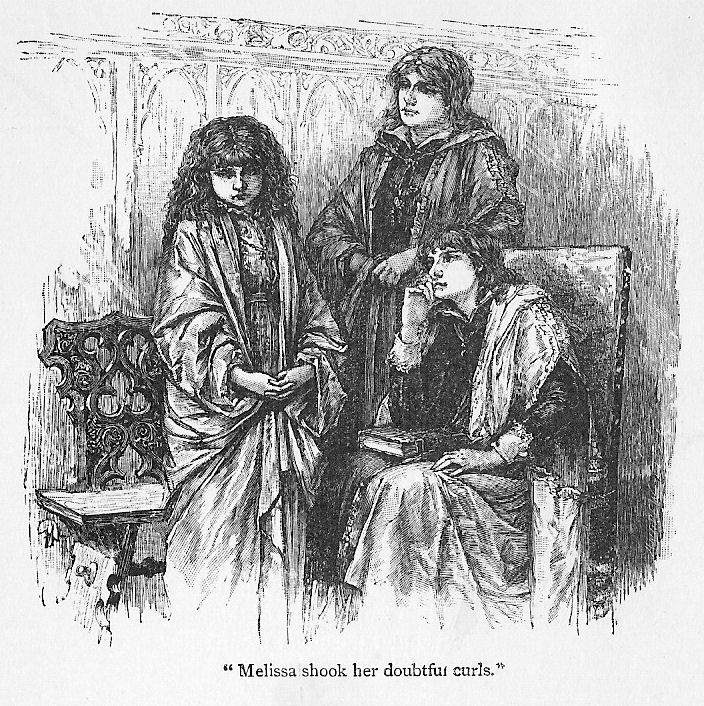
- Melissa shook her doubtful curls, and thought
- He scarce would prosper. 'Tell us,' Florian asked,
- 'How grew this feud betwixt the right and left.'
- 'O long ago,' she said, 'betwixt these two
- Division smoulders hidden; 'tis my mother,
- Too jealous, often fretful as the wind
- Pent in a crevice: much I bear with her:
- I never knew my father, but she says
- (God help her) she was wedded to a fool;
- And still she railed against the state of things.
- She had the care of Lady Ida's youth,
- And from the Queen's decease she brought her up.
- But when your sister came she won the heart
- Of Ida: they were still together, grew
- (For so they said themselves) inosculated;
- Consonant chords that shiver to one note;
- One mind in all things: yet my mother still
- Affirms your Psyche thieved her theories,
- And angled with them for her pupil's love:
- She calls her plagiarist; I know not what:
- But I must go: I dare not tarry,' and light,
- As flies the shadow of a bird, she fled.
- Then murmured Florian gazing after her,
- 'An open-hearted maiden, true and pure.
- If I could love, why this were she: how pretty
- Her blushing was, and how she blushed again,
- As if to close with Cyril's random wish:
- Not like your Princess crammed with erring pride,
- Nor like poor Psyche whom she drags in tow.'
- 'The crane,' I said, 'may chatter of the crane,
- The dove may murmur of the dove, but I
- An eagle clang an eagle to the sphere.
- My princess, O my princess! true she errs,
- But in her own grand way: being herself
- Three times more noble than three score of men,
- She sees herself in every woman else,
- And so she wears her error like a crown
- To blind the truth and me: for her, and her,
- Hebes are they to hand ambrosia, mix
- The nectar; but--ah she--whene'er she moves
- The Samian Herè rises and she speaks
- A Memnon smitten with the morning Sun.'
- So saying from the court we paced, and gained
- The terrace ranged along the Northern front,
- And leaning there on those balusters, high
- Above the empurpled champaign, drank the gale
- That blown about the foliage underneath,
- And sated with the innumerable rose,
- Beat balm upon our eyelids. Hither came
- Cyril, and yawning 'O hard task,' he cried;
- 'No fighting shadows here! I forced a way
- Through opposition crabbed and gnarled.
- Better to clear prime forests, heave and thump
- A league of street in summer solstice down,
- Than hammer at this reverend gentlewoman.
- I knocked and, bidden, entered; found her there
- At point to move, and settled in her eyes
- The green malignant light of coming storm.
- Sir, I was courteous, every phrase well-oiled,
- As man's could be; yet maiden-meek I prayed
- Concealment: she demanded who we were,
- And why we came? I fabled nothing fair,
- But, your example pilot, told her all.
- Up went the hushed amaze of hand and eye.
- But when I dwelt upon your old affiance,
- She answered sharply that I talked astray.
- I urged the fierce inscription on the gate,
- And our three lives. True--we had limed ourselves
- With open eyes, and we must take the chance.
- But such extremes, I told her, well might harm
- The woman's cause. "Not more than now," she said,
- "So puddled as it is with favouritism."
- I tried the mother's heart. Shame might befall
- Melissa, knowing, saying not she knew:
- Her answer was "Leave me to deal with that."
- I spoke of war to come and many deaths,
- And she replied, her duty was to speak,
- And duty duty, clear of consequences.
- I grew discouraged, Sir; but since I knew
- No rock so hard but that a little wave
- May beat admission in a thousand years,
- I recommenced; "Decide not ere you pause.
- I find you here but in the second place,
- Some say the third--the authentic foundress you.
- I offer boldly: we will seat you highest:
- Wink at our advent: help my prince to gain
- His rightful bride, and here I promise you
- Some palace in our land, where you shall reign
- The head and heart of all our fair she-world,
- And your great name flow on with broadening time
- For ever." Well, she balanced this a little,
- And told me she would answer us today,
- meantime be mute: thus much, nor more I gained.'
- He ceasing, came a message from the Head.
- 'That afternoon the Princess rode to take
- The dip of certain strata to the North.
- Would we go with her? we should find the land
- Worth seeing; and the river made a fall
- Out yonder:' then she pointed on to where
- A double hill ran up his furrowy forks
- Beyond the thick-leaved platans of the vale.
- Agreed to, this, the day fled on through all
- Its range of duties to the appointed hour.
- Then summoned to the porch we went. She stood
- Among her maidens, higher by the head,
- Her back against a pillar, her foot on one
- Of those tame leopards. Kittenlike he rolled
- And pawed about her sandal. I drew near;
- I gazed. On a sudden my strange seizure came
- Upon me, the weird vision of our house:
- The Princess Ida seemed a hollow show,
- Her gay-furred cats a painted fantasy,
- Her college and her maidens, empty masks,
- And I myself the shadow of a dream,
- For all things were and were not. Yet I felt
- My heart beat thick with passion and with awe;
- Then from my breast the involuntary sigh
- Brake, as she smote me with the light of eyes
- That lent my knee desire to kneel, and shook
- My pulses, till to horse we got, and so
- Went forth in long retinue following up
- The river as it narrowed to the hills.
- I rode beside her and to me she said:
- 'O friend, we trust that you esteemed us not
- Too harsh to your companion yestermorn;
- Unwillingly we spake.' 'No--not to her,'
- I answered, 'but to one of whom we spake
- Your Highness might have seemed the thing you say.'
- 'Again?' she cried, 'are you ambassadresses
- From him to me? we give you, being strange,
- A license: speak, and let the topic die.'
- I stammered that I knew him--could have wished--
- 'Our king expects--was there no precontract?
- There is no truer-hearted--ah, you seem
- All he prefigured, and he could not see
- The bird of passage flying south but longed
- To follow: surely, if your Highness keep
- Your purport, you will shock him even to death,
- Or baser courses, children of despair.'
- 'Poor boy,' she said, 'can he not read--no books?
- Quoit, tennis, ball--no games? nor deals in that
- Which men delight in, martial exercise?
- To nurse a blind ideal like a girl,
- Methinks he seems no better than a girl;
- As girls were once, as we ourself have been:
- We had our dreams; perhaps he mixt with them:
- We touch on our dead self, nor shun to do it,
- Being other--since we learnt our meaning here,
- To lift the woman's fallen divinity
- Upon an even pedestal with man.'
- She paused, and added with a haughtier smile
- 'And as to precontracts, we move, my friend,
- At no man's beck, but know ourself and thee,
- O Vashti, noble Vashti! Summoned out
- She kept her state, and left the drunken king
- To brawl at Shushan underneath the palms.'
- 'Alas your Highness breathes full East,' I said,
- 'On that which leans to you. I know the Prince,
- I prize his truth: and then how vast a work
- To assail this gray preëminence of man!
- You grant me license; might I use it? think;
- Ere half be done perchance your life may fail;
- Then comes the feebler heiress of your plan,
- And takes and ruins all; and thus your pains
- May only make that footprint upon sand
- Which old-recurring waves of prejudice
- Resmooth to nothing: might I dread that you,
- With only Fame for spouse and your great deeds
- For issue, yet may live in vain, and miss,
- Meanwhile, what every woman counts her due,
- Love, children, happiness?'
- And she exclaimed,
- 'Peace, you young savage of the Northern wild!
- What! though your Prince's love were like a God's,
- Have we not made ourself the sacrifice?
- You are bold indeed: we are not talked to thus:
- Yet will we say for children, would they grew
- Like field-flowers everywhere! we like them well:
- But children die; and let me tell you, girl,
- Howe'er you babble, great deeds cannot die;
- They with the sun and moon renew their light
- For ever, blessing those that look on them.
- Children--that men may pluck them from our hearts,
- Kill us with pity, break us with ourselves--
- O--children--there is nothing upon earth
- More miserable than she that has a son
- And sees him err: nor would we work for fame;
- Though she perhaps might reap the applause of Great,
|
|