Poets' Corner Home

    Selections from
    The Princess
    A Medley


    Prologue
    Part First
    Part Second
    Part Third
    Part Fourth
    Interlude
    Part Fifth
    Part Sixth
    Part Seventh
    Conclusion


    Bookshelf Edition Scripting
    © 2008 S.L. Spanoudis and
    theotherpages.org.
    All rights reserved worldwide.
    Poets' Corner Logo

    Click Illustration to Enlarge

    . P A R T   IV.

    'There sinks the nebulous star we call the Sun,
    If that hypothesis of theirs be sound'
    Said Ida; 'let us down and rest;' and we
    Down from the lean and wrinkled precipices,
    By every coppice-feathered chasm and cleft,
    Dropt through the ambrosial gloom to where below
    No bigger than a glow-worm shone the tent
    Lamp-lit from the inner. Once she leaned on me,
    Descending; once or twice she lent her hand,
    And blissful palpitations in the blood,
    Stirring a sudden transport rose and fell.

         But when we planted level feet, and dipt
    Beneath the satin dome and entered in,
    There leaning deep in broidered down we sank
    Our elbows: on a tripod in the midst
    A fragrant flame rose, and before us glowed
    Fruit, blossom, viand, amber wine, and gold.

         Then she, 'Let some one sing to us: lightlier move
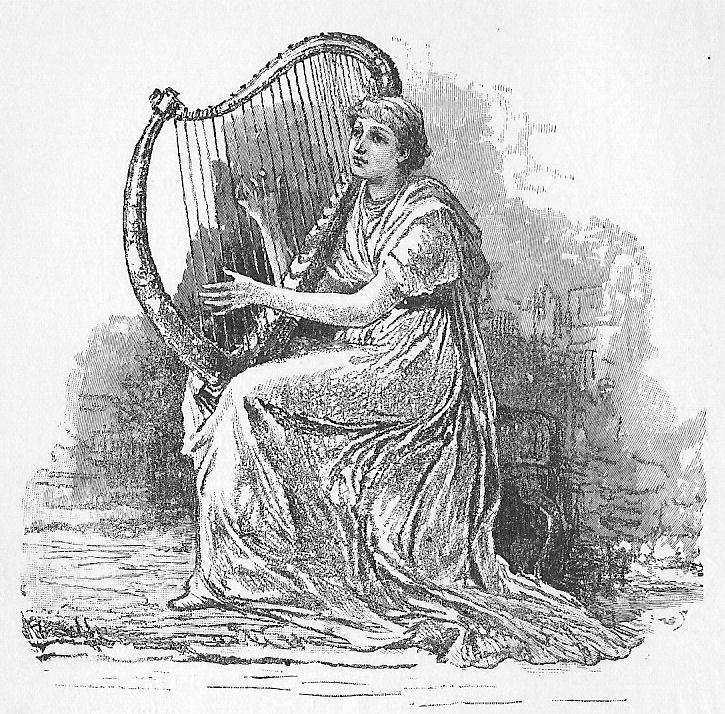
    The minutes fledged with music:' and a maid,
    Of those beside her, smote her harp, and sang.

         'Tears, idle tears, I know not what they mean,
    Tears from the depth of some divine despair
    Rise in the heart, and gather to the eyes,
    In looking on the happy Autumn-fields,
    And thinking of the days that are no more.

         'Fresh as the first beam glittering on a sail,
    That brings our friends up from the underworld,
    Sad as the last which reddens over one
    That sinks with all we love below the verge;
    So sad, so fresh, the days that are no more.

         'Ah, sad and strange as in dark summer dawns
    The earliest pipe of half-awakened birds
    To dying ears, when unto dying eyes
    The casement slowly grows a glimmering square;
    So sad, so strange, the days that are no more.

         'Dear as remembered kisses after death,
    And sweet as those by hopeless fancy feigned
    On lips that are for others; deep as love,
    Deep as first love, and wild with all regret;
    O Death in Life, the days that are no more.'

         She ended with such passion that the tear,
    She sang of, shook and fell, an erring pearl
    Lost in her bosom: but with some disdain
    Answered the Princess, 'If indeed there haunt
    About the mouldered lodges of the Past
    So sweet a voice and vague, fatal to men,
    Well needs it we should cram our ears with wool
    And so pace by: but thine are fancies hatched
    In silken-folded idleness; nor is it
    Wiser to weep a true occasion lost,
    But trim our sails, and let old bygones be,
    While down the streams that float us each and all
    To the issue, goes, like glittering bergs of ice,
    Throne after throne, and molten on the waste
    Becomes a cloud: for all things serve their time
    Toward that great year of equal mights and rights,
    Nor would I fight with iron laws, in the end
    Found golden: let the past be past; let be
    Their cancelled Babels: though the rough kex break
    The starred mosaic, and the beard-blown goat
    Hang on the shaft, and the wild figtree split
    Their monstrous idols, care not while we hear
    A trumpet in the distance pealing news
    Of better, and Hope, a poising eagle, burns
    Above the unrisen morrow:' then to me;
    'Know you no song of your own land,' she said,
    'Not such as moans about the retrospect,
    But deals with the other distance and the hues
    Of promise; not a death's-head at the wine.'

         Then I remembered one myself had made,
    What time I watched the swallow winging south
    From mine own land, part made long since, and part
    Now while I sang, and maidenlike as far
    As I could ape their treble, did I sing.

         'O Swallow, Swallow, flying, flying South,
    Fly to her, and fall upon her gilded eaves,
    And tell her, tell her, what I tell to thee.

         'O tell her, Swallow, thou that knowest each,
    That bright and fierce and fickle is the South,
    And dark and true and tender is the North.

         'O Swallow, Swallow, if I could follow, and light
    Upon her lattice, I would pipe and trill,
    And cheep and twitter twenty million loves.

         'O were I thou that she might take me in,
    And lay me on her bosom, and her heart
    Would rock the snowy cradle till I died.

         'Why lingereth she to clothe her heart with love,
    Delaying as the tender ash delays
    To clothe herself, when all the woods are green?

         'O tell her, Swallow, that thy brood is flown:
    Say to her, I do but wanton in the South,
    But in the North long since my nest is made.

         'O tell her, brief is life but love is long,
    And brief the sun of summer in the North,
    And brief the moon of beauty in the South.

         'O Swallow, flying from the golden woods,
    Fly to her, and pipe and woo her, and make her mine,
    And tell her, tell her, that I follow thee.'

         I ceased, and all the ladies, each at each,
    Like the Ithacensian suitors in old time,
    Stared with great eyes, and laughed with alien lips,
    And knew not what they meant; for still my voice
    Rang false: but smiling 'Not for thee,' she said,
    O Bulbul, any rose of Gulistan

    Shall burst her veil: marsh-divers, rather, maid,
    Shall croak thee sister, or the meadow-crake
    Grate her harsh kindred in the grass: and this
    A mere love-poem! O for such, my friend,
    We hold them slight: they mind us of the time
    When we made bricks in Egypt. Knaves are men,
    That lute and flute fantastic tenderness,
    And dress the victim to the offering up,
    And paint the gates of Hell with Paradise,
    And play the slave to gain the tyranny.
    Poor soul! I had a maid of honour once;
    She wept her true eyes blind for such a one,
    A rogue of canzonets and serenades.
    I loved her. Peace be with her. She is dead.
    So they blaspheme the muse! But great is song
    Used to great ends: ourself have often tried
    Valkyrian hymns, or into rhythm have dashed
    The passion of the prophetess; for song
    Is duer unto freedom, force and growth
    Of spirit than to junketing and love.
    Love is it? Would this same mock-love, and this
    Mock-Hymen were laid up like winter bats,
    Till all men grew to rate us at our worth,
    Not vassals to be beat, nor pretty babes
    To be dandled, no, but living wills, and sphered
    Whole in ourselves and owed to none. Enough!
    But now to leaven play with profit, you,
    Know you no song, the true growth of your soil,
    That gives the manners of your country-women?'

         She spoke and turned her sumptuous head with eyes
    Of shining expectation fixt on mine.
    Then while I dragged my brains for such a song,
    Cyril, with whom the bell-mouthed glass had wrought,
    Or mastered by the sense of sport, began
    To troll a careless, careless tavern-catch
    Of Moll and Meg, and strange experiences
    Unmeet for ladies. Florian nodded at him,
    I frowning; Psyche flushed and wanned and shook;
    The lilylike Melissa drooped her brows;
    'Forbear,' the Princess cried; 'Forbear, Sir' I;
    And heated through and through with wrath and love,
    I smote him on the breast; he started up;
    There rose a shriek as of a city sacked;
    Melissa clamoured 'Flee the death;' 'To horse'
    Said Ida; 'home! to horse!' and fled, as flies
    A troop of snowy doves athwart the dusk,
    When some one batters at the dovecote-doors,
    Disorderly the women. Alone I stood
    With Florian, cursing Cyril, vext at heart,
    In the pavilion: there like parting hopes
    I heard them passing from me: hoof by hoof,
    And every hoof a knell to my desires,
    Clanged on the bridge; and then another shriek,
    'The Head, the Head, the Princess, O the Head!'
    For blind with rage she missed the plank, and rolled
    In the river. Out I sprang from glow to gloom:
    There whirled her white robe like a blossomed branch
    Rapt to the horrible fall: a glance I gave,
    No more; but woman-vested as I was
    Plunged; and the flood drew; yet I caught her; then
    Oaring one arm, and bearing in my left
    The weight of all the hopes of half the world,
    Strove to buffet to land in vain. A tree
    Was half-disrooted from his place and stooped
    To wrench his dark locks in the gurgling wave
    Mid-channel. Right on this we drove and caught,
    And grasping down the boughs I gained the shore.

         There stood her maidens glimmeringly grouped
    In the hollow bank. One reaching forward drew
    My burthen from mine arms; they cried 'she lives:'
    They bore her back into the tent: but I,
    So much a kind of shame within me wrought,
    Not yet endured to meet her opening eyes,
    Nor found my friends; but pushed alone on foot
    (For since her horse was lost I left her mine)
    Across the woods, and less from Indian craft
    Than beelike instinct hiveward, found at length
    The garden portals. Two great statues, Art
    And Science, Caryatids, lifted up
    A weight of emblem, and betwixt were valves
    Of open-work in which the hunter rued
    His rash intrusion, manlike, but his brows
    Had sprouted, and the branches thereupon
    Spread out at top, and grimly spiked the gates.

         A little space was left between the horns,
    Through which I clambered o'er at top with pain,
    Dropt on the sward, and up the linden walks,
    And, tost on thoughts that changed from hue to hue,
    Now poring on the glowworm, now the star,
    I paced the terrace, till the Bear had wheeled
    Through a great arc his seven slow suns.
                                                                      A step
    Of lightest echo, then a loftier form
    Than female, moving through the uncertain gloom,
    Disturbed me with the doubt 'if this were she,'
    But it was Florian. 'Hist O Hist,' he said,
    'They seek us: out so late is out of rules.
    Moreover "seize the strangers" is the cry.
    How came you here?' I told him: 'I' said he,
    'Last of the train, a moral leper, I,
    To whom none spake, half-sick at heart, returned.
    Arriving all confused among the rest
    With hooded brows I crept into the hall,
    And, couched behind a Judith, underneath
    The head of Holofernes peeped and saw.
    Girl after girl was called to trial: each
    Disclaimed all knowledge of us: last of all,
    Melissa: trust me, Sir, I pitied her.
    She, questioned if she knew us men, at first
    Was silent; closer prest, denied it not:
    And then, demanded if her mother knew,
    Or Psyche, she affirmed not, or denied:
    From whence the Royal mind, familiar with her,
    Easily gathered either guilt. She sent
    For Psyche, but she was not there; she called
    For Psyche's child to cast it from the doors;
    She sent for Blanche to accuse her face to face;
    And I slipt out: but whither will you now?
    And where are Psyche, Cyril? both are fled:
    What, if together? that were not so well.
    Would rather we had never come! I dread
    His wildness, and the chances of the dark.'

         'And yet,' I said, 'you wrong him more than I
    That struck him: this is proper to the clown,
    Though smocked, or furred and purpled, still the clown,
    To harm the thing that trusts him, and to shame
    That which he says he loves: for Cyril, howe'er
    He deal in frolic, as tonight--the song
    Might have been worse and sinned in grosser lips
    Beyond all pardon--as it is, I hold
    These flashes on the surface are not he.
    He has a solid base of temperament:
    But as the waterlily starts and slides
    Upon the level in little puffs of wind,
    Though anchored to the bottom, such is he.'

         Scarce had I ceased when from a tamarisk near
    Two Proctors leapt upon us, crying, 'Names:'
    He, standing still, was clutched; but I began
    To thrid the musky-circled mazes, wind
    And double in and out the boles, and race
    By all the fountains: fleet I was of foot:
    Before me showered the rose in flakes; behind
    I heard the puffed pursuer; at mine ear
    Bubbled the nightingale and heeded not,
    And secret laughter tickled all my soul.
    At last I hooked my ankle in a vine,
    That claspt the feet of a Mnemosyne,
    And falling on my face was caught and known.

         They haled us to the Princess where she sat
    High in the hall: above her drooped a lamp,
    And made the single jewel on her brow
    Burn like the mystic fire on a mast-head,
    Prophet of storm: a handmaid on each side
    Bowed toward her, combing out her long black hair
    Damp from the river; and close behind her stood
    Eight daughters of the plough, stronger than men,
    Huge women blowzed with health, and wind, and rain,
    And labour. Each was like a Druid rock;
    Or like a spire of land that stands apart
    Cleft from the main, and wailed about with mews.

         Then, as we came, the crowd dividing clove
    An advent to the throne: and therebeside,
    Half-naked as if caught at once from bed
    And tumbled on the purple footcloth, lay
    The lily-shining child; and on the left,
    Bowed on her palms and folded up from wrong,
    Her round white shoulder shaken with her sobs,
    Melissa knelt; but Lady Blanche erect
    Stood up and spake, an affluent orator.

         'It was not thus, O Princess, in old days:
    You prized my counsel, lived upon my lips:
    I led you then to all the Castalies;
    I fed you with the milk of every Muse;
    I loved you like this kneeler, and you me
    Your second mother: those were gracious times.
    Then came your new friend: you began to change--
    I saw it and grieved--to slacken and to cool;
    Till taken with her seeming openness
    You turned your warmer currents all to her,
    To me you froze: this was my meed for all.
    Yet I bore up in part from ancient love,
    And partly that I hoped to win you back,
    And partly conscious of my own deserts,
    And partly that you were my civil head,
    And chiefly you were born for something great,
    In which I might your fellow-worker be,
    When time should serve; and thus a noble scheme
    Grew up from seed we two long since had sown;
    In us true growth, in her a Jonah's gourd,
    Up in one night and due to sudden sun:
    We took this palace; but even from the first
    You stood in your own light and darkened mine.
    What student came but that you planed her path
    To Lady Psyche, younger, not so wise,
    A foreigner, and I your countrywoman,
    I your old friend and tried, she new in all?
    But still her lists were swelled and mine were lean;
    Yet I bore up in hope she would be known:
    Then came these wolves: they knew her: they endured,
    Long-closeted with her the yestermorn,
    To tell her what they were, and she to hear:
    And me none told: not less to an eye like mine
    A lidless watcher of the public weal,
    Last night, their mask was patent, and my foot
    Was to you: but I thought again: I feared
    To meet a cold "We thank you, we shall hear of it
    From Lady Psyche:" you had gone to her,
    She told, perforce; and winning easy grace
    No doubt, for slight delay, remained among us
    In our young nursery still unknown, the stem
    Less grain than touchwood, while my honest heat
    Were all miscounted as malignant haste
    To push my rival out of place and power.
    But public use required she should be known;
    And since my oath was ta'en for public use,
    I broke the letter of it to keep the sense.
    I spoke not then at first, but watched them well,
    Saw that they kept apart, no mischief done;
    And yet this day (though you should hate me for it)

    Click Illustration to Enlarge
    I came to tell you; found that you had gone,
    Ridden to the hills, she likewise: now, I thought,
    That surely she will speak; if not, then I:
    Did she? These monsters blazoned what they were,
    According to the coarseness of their kind,
    For thus I hear; and known at last (my work)
    And full of cowardice and guilty shame,
    I grant in her some sense of shame, she flies;
    And I remain on whom to wreak your rage,
    I, that have lent my life to build up yours,
    I that have wasted here health, wealth, and time,
    And talent, I--you know it--I will not boast:
    Dismiss me, and I prophesy your plan,
    Divorced from my experience, will be chaff
    For every gust of chance, and men will say
    We did not know the real light, but chased
    The wisp that flickers where no foot can tread.'

         She ceased: the Princess answered coldly, 'Good:
    Your oath is broken: we dismiss you: go.
    For this lost lamb (she pointed to the child)
    Our mind is changed: we take it to ourself.'

         Thereat the Lady stretched a vulture throat,
    And shot from crooked lips a haggard smile.
    'The plan was mine. I built the nest' she said
    'To hatch the cuckoo. Rise!' and stooped to updrag
    Melissa: she, half on her mother propt,
    Half-drooping from her, turned her face, and cast
    A liquid look on Ida, full of prayer,
    Which melted Florian's fancy as she hung,
    A Niobėan daughter, one arm out,
    Appealing to the bolts of Heaven; and while
    We gazed upon her came a little stir
    About the doors, and on a sudden rushed
    Among us, out of breath as one pursued,
    A woman-post in flying raiment. Fear
    Stared in her eyes, and chalked her face, and winged
    Her transit to the throne, whereby she fell
    Delivering sealed dispatches which the Head
    Took half-amazed, and in her lion's mood
    Tore open, silent we with blind surmise
    Regarding, while she read, till over brow
    And cheek and bosom brake the wrathful bloom
    As of some fire against a stormy cloud,
    When the wild peasant rights himself, the rick
    Flames, and his anger reddens in the heavens;
    For anger most it seemed, while now her breast,
    Beaten with some great passion at her heart,
    Palpitated, her hand shook, and we heard
    In the dead hush the papers that she held
    Rustle: at once the lost lamb at her feet
    Sent out a bitter bleating for its dam;
    The plaintive cry jarred on her ire; she crushed
    The scrolls together, made a sudden turn
    As if to speak, but, utterance failing her,
    She whirled them on to me, as who should say
    'Read,' and I read--two letters--one her sire's.

         'Fair daughter, when we sent the Prince your way,
    We knew not your ungracious laws, which learnt,
    We, conscious of what temper you are built,
    Came all in haste to hinder wrong, but fell
    Into his father's hands, who has this night,
    You lying close upon his territory,
    Slipt round and in the dark invested you,
    And here he keeps me hostage for his son.'

         The second was my father's running thus:
    'You have our son: touch not a hair of his head:
    Render him up unscathed: give him your hand:
    Cleave to your contract: though indeed we hear
    You hold the woman is the better man;
    A rampant heresy, such as if it spread
    Would make all women kick against their Lords
    Through all the world, and which might well deserve
    That we this night should pluck your palace down;
    And we will do it, unless you send us back
    Our son, on the instant, whole.'
                                                       So far I read;
    And then stood up and spoke impetuously.

         'O not to pry and peer on your reserve,
    But led by golden wishes, and a hope
    The child of regal compact, did I break
    Your precinct; not a scorner of your sex
    But venerator, zealous it should be
    All that it might be: hear me, for I bear,
    Though man, yet human, whatsoe'er your wrongs,
    From the flaxen curl to the gray lock a life
    Less mine than yours: my nurse would tell me of you;
    I babbled for you, as babies for the moon,
    Vague brightness; when a boy, you stooped to me
    From all high places, lived in all fair lights,
    Came in long breezes rapt from inmost south
    And blown to inmost north; at eve and dawn
    With Ida, Ida, Ida, rang the woods;
    The leader wildswan in among the stars
    Would clang it, and lapt in wreaths of glowworm light
    The mellow breaker murmured Ida. Now,
    Because I would have reached you, had you been
    Sphered up with Cassiopėia, or the enthroned
    Persephonč in Hades, now at length,
    Those winters of abeyance all worn out,
    A man I came to see you: but indeed,
    Not in this frequence can I lend full tongue,
    O noble Ida, to those thoughts that wait
    On you, their centre: let me say but this,
    That many a famous man and woman, town
    And landskip, have I heard of, after seen
    The dwarfs of presage: though when known, there grew
    Another kind of beauty in detail
    Made them worth knowing; but in your I found
    My boyish dream involved and dazzled down
    And mastered, while that after-beauty makes
    Such head from act to act, from hour to hour,
    Within me, that except you slay me here,
    According to your bitter statute-book,
    I cannot cease to follow you, as they say
    The seal does music; who desire you more
    Than growing boys their manhood; dying lips,
    With many thousand matters left to do,
    The breath of life; O more than poor men wealth,
    Than sick men health--yours, yours, not mine--but half
    Without you; with you, whole; and of those halves
    You worthiest; and howe'er you block and bar
    Your heart with system out from mine, I hold
    That it becomes no man to nurse despair,
    But in the teeth of clenched antagonisms
    To follow up the worthiest till he die:
    Yet that I came not all unauthorized
    Behold your father's letter.'
                                                  On one knee
    Kneeling, I gave it, which she caught, and dashed
    Unopened at her feet: a tide of fierce
    Invective seemed to wait behind her lips,
    As waits a river level with the dam
    Ready to burst and flood the world with foam:
    And so she would have spoken, but there rose
    A hubbub in the court of half the maids
    Gathered together: from the illumined hall
    Long lanes of splendour slanted o'er a press
    Of snowy shoulders, thick as herded ewes,
    And rainbow robes, and gems and gemlike eyes,
    And gold and golden heads; they to and fro
    Fluctuated, as flowers in storm, some red, some pale,
    All open-mouthed, all gazing to the light,
    Some crying there was an army in the land,
    And some that men were in the very walls,
    And some they cared not; till a clamour grew
    As of a new-world Babel, woman-built,
    And worse-confounded: high above them stood
    The placid marble Muses, looking peace.

    Click Illustration to Enlarge
         Not peace she looked, the Head: but rising up
    Robed in the long night of her deep hair, so
    To the open window moved, remaining there
    Fixt like a beacon-tower above the waves
    Of tempest, when the crimson-rolling eye
    Glares ruin, and the wild birds on the light
    Dash themselves dead. She stretched her arms and called
    Across the tumult and the tumult fell.

         'What fear ye, brawlers? am not I your Head?
    On me, me, me, the storm first breaks: I dare
    All these male thunderbolts: what is it ye fear?
    Peace! there are those to avenge us and they come:
    If not,--myself were like enough, O girls,
    To unfurl the maiden banner of our rights,
    And clad in iron burst the ranks of war,
    Or, falling, promartyr of our cause,
    Die: yet I blame you not so much for fear:
    Six thousand years of fear have made you that
    From which I would redeem you: but for those
    That stir this hubbub--you and you--I know
    Your faces there in the crowd--tomorrow morn
    We hold a great convention: then shall they
    That love their voices more than duty, learn
    With whom they deal, dismissed in shame to live
    No wiser than their mothers, household stuff,
    Live chattels, mincers of each other's fame,
    Full of weak poison, turnspits for the clown,
    The drunkard's football, laughing-stocks of Time,
    Whose brains are in their hands and in their heels
    But fit to flaunt, to dress, to dance, to thrum,
    To tramp, to scream, to burnish, and to scour,
    For ever slaves at home and fools abroad.'

         She, ending, waved her hands: thereat the crowd
    Muttering, dissolved: then with a smile, that looked
    A stroke of cruel sunshine on the cliff,
    When all the glens are drowned in azure gloom
    Of thunder-shower, she floated to us and said:

         'You have done well and like a gentleman,
    And like a prince: you have our thanks for all:
    And you look well too in your woman's dress:
    Well have you done and like a gentleman.
    You saved our life: we owe you bitter thanks:
    Better have died and spilt our bones in the flood--
    Then men had said--but now--What hinders me
    To take such bloody vengeance on you both?--
    Yet since our father--Wasps in our good hive,
    You would-be quenchers of the light to be,
    Barbarians, grosser than your native bears--
    O would I had his sceptre for one hour!
    You that have dared to break our bound, and gulled
    Our servants, wronged and lied and thwarted us--
    I wed with thee! I bound by precontract
    Your bride, our bondslave! not though all the gold
    That veins the world were packed to make your crown,
    And every spoken tongue should lord you. Sir,
    Your falsehood and yourself are hateful to us:
    I trample on your offers and on you:
    Begone: we will not look upon you more.
    Here, push them out at gates.'
                                                      In wrath she spake.
    Then those eight mighty daughters of the plough
    Bent their broad faces toward us and addressed
    Their motion: twice I sought to plead my cause,
    But on my shoulder hung their heavy hands,
    The weight of destiny: so from her face
    They pushed us, down the steps, and through the court,
    And with grim laughter thrust us out at gates.

         We crossed the street and gained a petty mound
    Beyond it whence we saw the lights and heard
    The voices murmuring. While I listened, came
    On a sudden the weird seizure and the doubt:
    I seemed to move among a world of ghosts;
    The Princess with her monstrous woman-guard,
    The jest and earnest working side by side,
    The cataract and the tumult and the kings
    Were shadows; and the long fantastic night
    With all its doings had and had not been,
    And all things were and were not.
                                                           This went by
    As strangely as it came, and on my spirits
    Settled a gentle cloud of melancholy;
    Not long; I shook it off; for spite of doubts
    And sudden ghostly shadowings I was one
    To whom the touch of all mischance but came
    As night to him that sitting on a hill
    Sees the midsummer, midnight, Norway sun
    Set into sunrise; then we moved away.


    . I N T E R L U D E.

         Thy voice is heard through rolling drums,
              That beat to battle where he stands;
         Thy face across his fancy comes,
              And gives the battle to his hands:
         A moment, while the trumpets blow,
              He sees his brood about thy knee;
         The next, like fire he meets the foe,
              And strikes him dead for thine and thee.

    So Lilia sang: we thought her half-possessed,
    She struck such warbling fury through the words;
    And, after, feigning pique at what she called
    The raillery, or grotesque, or false sublime--
    Like one that wishes at a dance to change
    The music--clapt her hands and cried for war,
    Or some grand fight to kill and make an end:
    And he that next inherited the tale
    Half turning to the broken statue, said,
    'Sir Ralph has got your colours: if I prove
    Your knight, and fight your battle, what for me?'
    It chanced, her empty glove upon the tomb
    Lay by her like a model of her hand.
    She took it and she flung it. 'Fight' she said,
    'And make us all we would be, great and good.'
    He knightlike in his cap instead of casque,
    A cap of Tyrol borrowed from the hall,
    Arranged the favour, and assumed the Prince.

                On to Part V

    Poets' Corner - Home    |    The Other Pages

    ©1994-2020 Poets' Corner Editorial Staff, All Rights Reserved Worldwide