| |
|

- My dream had never died or lived again.
- As in some mystic middle state I lay;
- Seeing I saw not, hearing not I heard:
- Though, if I saw not, yet they told me all
- So often that I speak as having seen.
- For so it seemed, or so they said to me,
- That all things grew more tragic and more strange;
- That when our side was vanquished and my cause
- For ever lost, there went up a great cry,
- The Prince is slain. My father heard and ran
- In on the lists, and there unlaced my casque
- And grovelled on my body, and after him
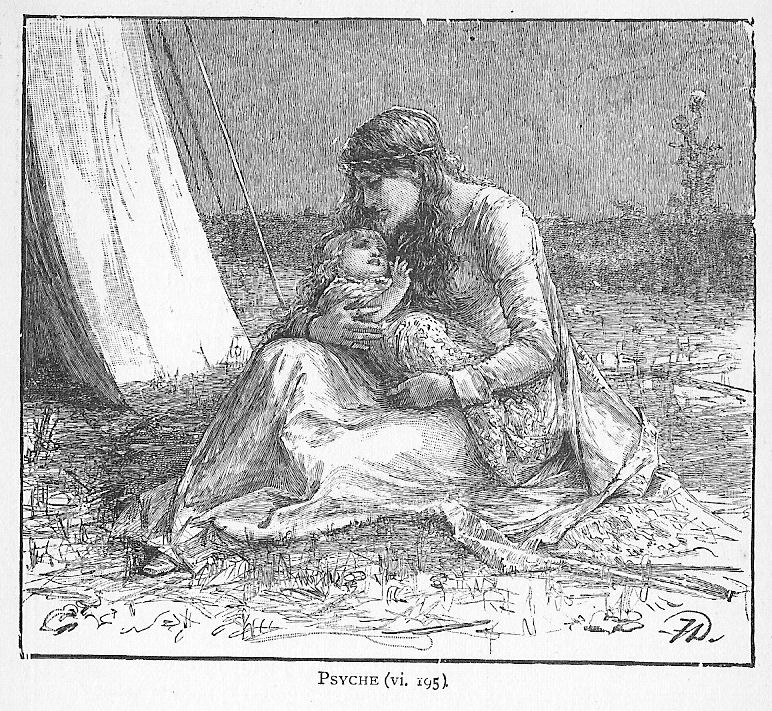
- Came Psyche, sorrowing for Aglaïa.
- But high upon the palace Ida stood
- With Psyche's babe in arm: there on the roofs
- Like that great dame of Lapidoth she sang.
- 'Our enemies have fallen, have fallen: the seed,
- The little seed they laughed at in the dark,
- Has risen and cleft the soil, and grown a bulk
- Of spanless girth, that lays on every side
- A thousand arms and rushes to the Sun.
- 'Our enemies have fallen, have fallen: they came;
- The leaves were wet with women's tears: they heard
- A noise of songs they would not understand:
- They marked it with the red cross to the fall,
- And would have strown it, and are fallen themselves.
- 'Our enemies have fallen, have fallen: they came,
- The woodmen with their axes: lo the tree!
- But we will make it faggots for the hearth,
- And shape it plank and beam for roof and floor,
- And boats and bridges for the use of men.
- 'Our enemies have fallen, have fallen: they struck;
- With their own blows they hurt themselves, nor knew
- There dwelt an iron nature in the grain:
- The glittering axe was broken in their arms,
- Their arms were shattered to the shoulder blade.
- 'Our enemies have fallen, but this shall grow
- A night of Summer from the heat, a breadth
- Of Autumn, dropping fruits of power: and rolled
- With music in the growing breeze of Time,
- The tops shall strike from star to star, the fangs
- Shall move the stony bases of the world.
- 'And now, O maids, behold our sanctuary
- Is violate, our laws broken: fear we not
- To break them more in their behoof, whose arms
- Championed our cause and won it with a day
- Blanched in our annals, and perpetual feast,
- When dames and heroines of the golden year
- Shall strip a hundred hollows bare of Spring,
- To rain an April of ovation round
- Their statues, borne aloft, the three: but come,
- We will be liberal, since our rights are won.
- Let them not lie in the tents with coarse mankind,
- Ill nurses; but descend, and proffer these
- The brethren of our blood and cause, that there
- Lie bruised and maimed, the tender ministries
- Of female hands and hospitality.'
- She spoke, and with the babe yet in her arms,
- Descending, burst the great bronze valves, and led
- A hundred maids in train across the Park.
- Some cowled, and some bare-headed, on they came,
- Their feet in flowers, her loveliest: by them went
- The enamoured air sighing, and on their curls
- From the high tree the blossom wavering fell,
- And over them the tremulous isles of light
- Slided, they moving under shade: but Blanche
- At distance followed: so they came: anon
- Through open field into the lists they wound
- Timorously; and as the leader of the herd
- That holds a stately fretwork to the Sun,
- And followed up by a hundred airy does,
- Steps with a tender foot, light as on air,
- The lovely, lordly creature floated on
- To where her wounded brethren lay; there stayed;
- Knelt on one knee,--the child on one,--and prest
- Their hands, and called them dear deliverers,
- And happy warriors, and immortal names,
- And said 'You shall not lie in the tents but here,
- And nursed by those for whom you fought, and served
- With female hands and hospitality.'
- Then, whether moved by this, or was it chance,
- She past my way. Up started from my side
- The old lion, glaring with his whelpless eye,
- Silent; but when she saw me lying stark,
- Dishelmed and mute, and motionlessly pale,
- Cold even to her, she sighed; and when she saw
- The haggard father's face and reverend beard
- Of grisly twine, all dabbled with the blood
- Of his own son, shuddered, a twitch of pain
- Tortured her mouth, and o'er her forehead past
- A shadow, and her hue changed, and she said:
- 'He saved my life: my brother slew him for it.'
- No more: at which the king in bitter scorn
- Drew from my neck the painting and the tress,
- And held them up: she saw them, and a day
- Rose from the distance on her memory,
- When the good Queen, her mother, shore the tress
- With kisses, ere the days of Lady Blanche:
- And then once more she looked at my pale face:
- Till understanding all the foolish work
- Of Fancy, and the bitter close of all,
- Her iron will was broken in her mind;
- Her noble heart was molten in her breast;
- She bowed, she set the child on the earth; she laid
- A feeling finger on my brows, and presently
- 'O Sire,' she said, 'he lives: he is not dead:
- O let me have him with my brethren here
- In our own palace: we will tend on him
- Like one of these; if so, by any means,
- To lighten this great clog of thanks, that make
- Our progress falter to the woman's goal.'
- She said: but at the happy word 'he lives'
- My father stooped, re-fathered o'er my wounds.
- So those two foes above my fallen life,
- With brow to brow like night and evening mixt
- Their dark and gray, while Psyche ever stole
- A little nearer, till the babe that by us,
- Half-lapt in glowing gauze and golden brede,
- Lay like a new-fallen meteor on the grass,
- Uncared for, spied its mother and began
- A blind and babbling laughter, and to dance
- Its body, and reach its fatling innocent arms
- And lazy lingering fingers. She the appeal
- Brooked not, but clamouring out 'Mine--mine--not yours,
- It is not yours, but mine: give me the child'
- Ceased all on tremble: piteous was the cry:
- So stood the unhappy mother open-mouthed,
- And turned each face her way: wan was her cheek
- With hollow watch, her blooming mantle torn,
- Red grief and mother's hunger in her eye,
- And down dead-heavy sank her curls, and half
- The sacred mother's bosom, panting, burst
- The laces toward her babe; but she nor cared
- Nor knew it, clamouring on, till Ida heard,
- Looked up, and rising slowly from me, stood
- Erect and silent, striking with her glance
- The mother, me, the child; but he that lay
- Beside us, Cyril, battered as he was,
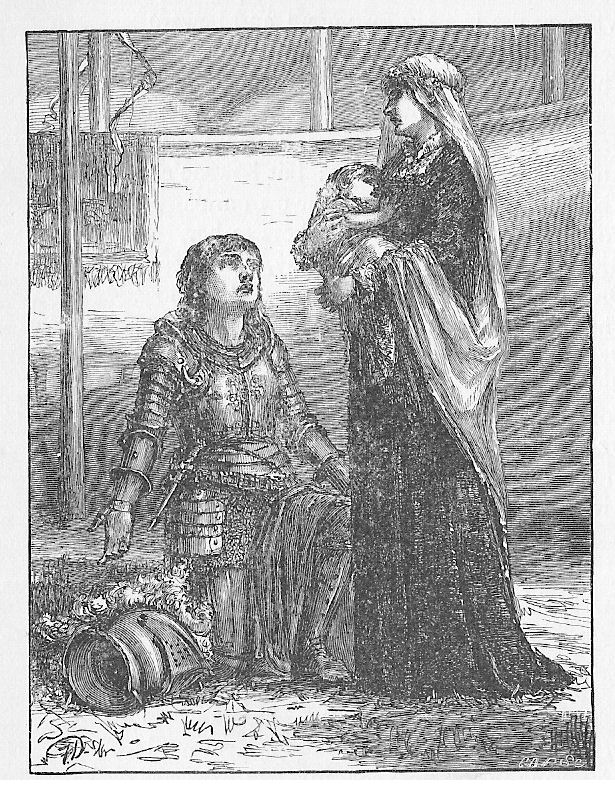
- Trailed himself up on one knee: then he drew
- Her robe to meet his lips, and down she looked
- At the armed man sideways, pitying as it seemed,
- Or self-involved; but when she learnt his face,
- Remembering his ill-omened song, arose
- Once more through all her height, and o'er him grew
- Tall as a figure lengthened on the sand
- When the tide ebbs in sunshine, and he said:
- 'O fair and strong and terrible! Lioness
- That with your long locks play the Lion's mane!
- But Love and Nature, these are two more terrible
- And stronger. See, your foot is on our necks,
- We vanquished, you the Victor of your will.
- What would you more? Give her the child! remain
- Orbed in your isolation: he is dead,
- Or all as dead: henceforth we let you be:
- Win you the hearts of women; and beware
- Lest, where you seek the common love of these,
- The common hate with the revolving wheel
- Should drag you down, and some great Nemesis
- Break from a darkened future, crowned with fire,
- And tread you out for ever: but howso'er
- Fixed in yourself, never in your own arms
- To hold your own, deny not hers to her,
- Give her the child! O if, I say, you keep
- One pulse that beats true woman, if you loved
- The breast that fed or arm that dandled you,
- Or own one port of sense not flint to prayer,
- Give her the child! or if you scorn to lay it,
- Yourself, in hands so lately claspt with yours,
- Or speak to her, your dearest, her one fault,
- The tenderness, not yours, that could not kill,
- Give me it: I will give it her.
-
- At first her eye with slow dilation rolled
- Dry flame, she listening; after sank and sank
- And, into mournful twilight mellowing, dwelt
- Full on the child; she took it: 'Pretty bud!
- Lily of the vale! half opened bell of the woods!
- Sole comfort of my dark hour, when a world
- Of traitorous friend and broken system made
- No purple in the distance, mystery,
- Pledge of a love not to be mine, farewell;
- These men are hard upon us as of old,
- We two must part: and yet how fain was I
- To dream thy cause embraced in mine, to think
- I might be something to thee, when I felt
- Thy helpless warmth about my barren breast
- In the dead prime: but may thy mother prove
- As true to thee as false, false, false to me!
- And, if thou needs must needs bear the yoke, I wish it
- Gentle as freedom'--here she kissed it: then--
- 'All good go with thee! take it Sir,' and so
- Laid the soft babe in his hard-mailèd hands,
- Who turned half-round to Psyche as she sprang
- To meet it, with an eye that swum in thanks;
- Then felt it sound and whole from head to foot,
- And hugged and never hugged it close enough,
- And in her hunger mouthed and mumbled it,
- And hid her bosom with it; after that
- Put on more calm and added suppliantly:
- 'We two were friends: I go to mine own land
- For ever: find some other: as for me
- I scarce am fit for your great plans: yet speak to me,
- Say one soft word and let me part forgiven.'
- But Ida spoke not, rapt upon the child.
- Then Arac. 'Ida--'sdeath! you blame the man;
- You wrong yourselves--the woman is so hard
- Upon the woman. Come, a grace to me!
- I am your warrior: I and mine have fought
- Your battle: kiss her; take her hand, she weeps:
- 'Sdeath! I would sooner fight thrice o'er than see it.'
- But Ida spoke not, gazing on the ground,
- And reddening in the furrows of his chin,
- And moved beyond his custom, Gama said:
- 'I've heard that there is iron in the blood,
- And I believe it. Not one word? not one?
- Whence drew you this steel temper? not from me,
- Not from your mother, now a saint with saints.
- She said you had a heart--I heard her say it--
- "Our Ida has a heart"--just ere she died--
- "But see that some on with authority
- Be near her still" and I--I sought for one--
- All people said she had authority--
- The Lady Blanche: much profit! Not one word;
- No! though your father sues: see how you stand
- Stiff as Lot's wife, and all the good knights maimed,
- I trust that there is no one hurt to death,
- For our wild whim: and was it then for this,
- Was it for this we gave our palace up,
- Where we withdrew from summer heats and state,
- And had our wine and chess beneath the planes,
- And many a pleasant hour with her that's gone,
- Ere you were born to vex us? Is it kind?
- Speak to her I say: is this not she of whom,
- When first she came, all flushed you said to me
- Now had you got a friend of your own age,
- Now could you share your thought; now should men see
- Two women faster welded in one love
- Than pairs of wedlock; she you walked with, she
- You talked with, whole nights long, up in the tower,
- Of sine and arc, spheroïd and azimuth,
- And right ascension, Heaven knows what; and now
- A word, but one, one little kindly word,
- Not one to spare her: out upon you, flint!
- You love nor her, nor me, nor any; nay,
- You shame your mother's judgment too. Not one?
- You will not? well--no heart have you, or such
|
|