Poets' Corner Home

    Selections from
    The Princess
    A Medley


    Prologue
    Part First
    Part Second
    Part Third
    Part Fourth
    Interlude
    Part Fifth
    Part Sixth
    Part Seventh
    Conclusion


    Bookshelf Edition Scripting
    © 2008 S.L. Spanoudis and
    theotherpages.org.
    All rights reserved worldwide.
    Poets' Corner Logo

    Click Illustration to Enlarge

    . P A R T   II.

    At break of day the College Portress came:
    She brought us Academic silks, in hue
    The lilac, with a silken hood to each,
    And zoned with gold; and now when these were on,
    And we as rich as moths from dusk cocoons,
    She, curtseying her obeisance, let us know
    The Princess Ida waited: out we paced,
    I first, and following through the porch that sang
    All round with laurel, issued in a court
    Compact of lucid marbles, bossed with lengths
    Of classic frieze, with ample awnings gay
    Betwixt the pillars, and with great urns of flowers.
    The Muses and the Graces, grouped in threes,
    Enringed a billowing fountain in the midst;
    And here and there on lattice edges lay
    Or book or lute; but hastily we past,
    And up a flight of stairs into the hall.

         There at a board by tome and paper sat,
    With two tame leopards couched beside her throne,
    All beauty compassed in a female form,
    The Princess; liker to the inhabitant
    Of some clear planet close upon the Sun,
    Than our man's earth; such eyes were in her head,
    And so much grace and power, breathing down
    From over her arched brows, with every turn
    Lived through her to the tips of her long hands,
    And to her feet. She rose her height, and said:

         'We give you welcome: not without redound
    Of use and glory to yourselves ye come,
    The first-fruits of the stranger: aftertime,
    And that full voice which circles round the grave,
    Will rank you nobly, mingled up with me.
    What! are the ladies of your land so tall?'
    'We of the court' said Cyril. 'From the court'
    She answered, 'then ye know the Prince?' and he:
    'The climax of his age! as though there were
    One rose in all the world, your Highness that,
    He worships your ideal:' she replied:
    'We scarcely thought in our own hall to hear
    This barren verbiage, current among men,
    Light coin, the tinsel clink of compliment.
    Your flight from out your bookless wilds would seem
    As arguing love of knowledge and of power;
    Your language proves you still the child. Indeed,
    We dream not of him: when we set our hand
    To this great work, we purposed with ourself
    Never to wed. You likewise will do well,
    Ladies, in entering here, to cast and fling
    The tricks, which make us toys of men, that so,
    Some future time, if so indeed you will,
    You may with those self-styled our lords ally
    Your fortunes, justlier balanced, scale with scale.'

         At those high words, we conscious of ourselves,
    Perused the matting: then an officer
    Rose up, and read the statutes, such as these:
    Not for three years to correspond with home;
    Not for three years to cross the liberties;
    Not for three years to speak with any men;
    And many more, which hastily subscribed,
    We entered on the boards: and 'Now,' she cried,
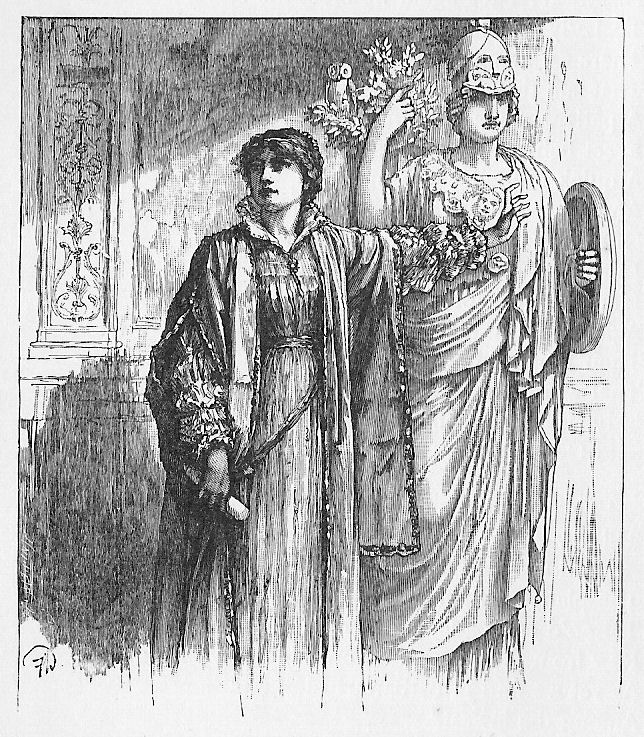
    'Ye are green wood, see ye warp not. Look, our hall!
    Our statues!--not of those that men desire,
    Sleek Odalisques, or oracles of mode,
    Nor stunted squaws of West or East; but she
    That taught the Sabine how to rule, and she
    The foundress of the Babylonian wall,
    The Carian Artemisia strong in war,
    The Rhodope, that built the pyramid,
    Clelia, Cornelia, with the Palmyrene
    That fought Aurelian, and the Roman brows
    Of Agrippina. Dwell with these, and lose
    Convention, since to look on noble forms
    Makes noble through the sensuous organism
    That which is higher. O lift your natures up:
    Embrace our aims: work out your freedom. Girls,
    Knowledge is now no more a fountain sealed:
    Drink deep, until the habits of the slave,
    The sins of emptiness, gossip and spite
    And slander, die. Better not be at all
    Than not be noble. Leave us: you may go:
    Today the Lady Psyche will harangue
    The fresh arrivals of the week before;
    For they press in from all the provinces,
    And fill the hive.'
                               She spoke, and bowing waved
    Dismissal: back again we crost the court
    To Lady Psyche's: as we entered in,
    There sat along the forms, like morning doves
    That sun their milky bosoms on the thatch,
    A patient range of pupils; she herself
    Erect behind a desk of satin-wood,
    A quick brunette, well-moulded, falcon-eyed,
    And on the hither side, or so she looked,
    Of twenty summers. At her left, a child,
    In shining draperies, headed like a star,
    Her maiden babe, a double April old,
    Aglaïa slept. We sat: the Lady glanced:
    Then Florian, but not livelier than the dame
    That whispered 'Asses' ears', among the sedge,
    'My sister.' 'Comely, too, by all that's fair,'
    Said Cyril. 'Oh hush, hush!' and she began.

         'This world was once a fluid haze of light,
    Till toward the centre set the starry tides,
    And eddied into suns, that wheeling cast
    The planets: then the monster, then the man;
    Tattooed or woaded, winter-clad in skins,
    Raw from the prime, and crushing down his mate;
    As yet we find in barbarous isles, and here
    Among the lowest.'
                                  Thereupon she took
    A bird's-eye-view of all the ungracious past;
    Glanced at the legendary Amazon
    As emblematic of a nobler age;
    Appraised the Lycian custom, spoke of those
    That lay at wine with Lar and Lucumo;
    Ran down the Persian, Grecian, Roman lines
    Of empire, and the woman's state in each,
    How far from just; till warming with her theme
    She fulmined out her scorn of laws Salique
    Click Illustration to Enlarge
    And little-footed China, touched on Mahomet
    With much contempt, and came to chivalry:
    When some respect, however slight, was paid
    To woman, superstition all awry:
    However then commenced the dawn: a beam
    Had slanted forward, falling in a land
    Of promise; fruit would follow. Deep, indeed,
    Their debt of thanks to her who first had dared
    To leap the rotten pales of prejudice,
    Disyoke their necks from custom, and assert
    None lordlier than themselves but that which made
    Woman and man. She had founded; they must build.
    Here might they learn whatever men were taught:
    Let them not fear: some said their heads were less:
    Some men's were small; not they the least of men;
    For often fineness compensated size:
    Besides the brain was like the hand, and grew
    With using; thence the man's, if more was more;
    He took advantage of his strength to be
    First in the field: some ages had been lost;
    But woman ripened earlier, and her life
    Was longer; and albeit their glorious names
    Were fewer, scattered stars, yet since in truth
    The highest is the measure of the man,
    And not the Kaffir, Hottentot, Malay,
    Nor those horn-handed breakers of the glebe,
    But Homer, Plato, Verulam; even so
    With woman: and in arts of government
    Elizabeth and others; arts of war
    The peasant Joan and others; arts of grace
    Sappho and others vied with any man:
    And, last not least, she who had left her place,
    And bowed her state to them, that they might grow
    To use and power on this Oasis, lapt
    In the arms of leisure, sacred from the blight
    Of ancient influence and scorn.
                                                  At last
    She rose upon a wind of prophecy
    Dilating on the future; 'everywhere
    Who heads in council, two beside the hearth,
    Two in the tangled business of the world,
    Two in the liberal offices of life,
    Two plummets dropt for one to sound the abyss
    Of science, and the secrets of the mind:
    Musician, painter, sculptor, critic, more:
    And everywhere the broad and bounteous Earth
    Should bear a double growth of those rare souls,
    Poets, whose thoughts enrich the blood of the world.'
         She ended here, and beckoned us: the rest
    Parted; and, glowing full-faced welcome, she
    Began to address us, and was moving on
    In gratulation, till as when a boat
    Tacks, and the slackened sail flaps, all her voice
    Faltering and fluttering in her throat, she cried
    'My brother!' 'Well, my sister.' 'O,' she said,
    'What do you here? and in this dress? and these?
    Why who are these? a wolf within the fold!
    A pack of wolves! the Lord be gracious to me!
    A plot, a plot, a plot to ruin all!'
    'No plot, no plot,' he answered. 'Wretched boy,
    How saw you not the inscription on the gate,
    LET NO MAN ENTER IN ON PAIN OF DEATH?'
    'And if I had,' he answered, 'who could think
    The softer Adams of your Academe,
    O sister, Sirens though they be, were such
    As chanted on the blanching bones of men?'
    'But you will find it otherwise' she said.
    'You jest: ill jesting with edge-tools! my vow
    Binds me to speak, and O that iron will,
    That axelike edge unturnable, our Head,
    The Princess.' 'Well then, Psyche, take my life,
    And nail me like a weasel on a grange
    For warning: bury me beside the gate,
    And cut this epitaph above my bones;
    Here lies a brother by a sister slain,
    All for the common good of womankind.'
    'Let me die too,' said Cyril, 'having seen
    And heard the Lady Psyche.'
                                                 I struck in:
    'Albeit so masked, Madam, I love the truth;
    Receive it; and in me behold the Prince
    Your countryman, affianced years ago
    To the Lady Ida: here, for here she was,
    And thus (what other way was left) I came.'
    'O Sir, O Prince, I have no country; none;
    If any, this; but none. Whate'er I was
    Disrooted, what I am is grafted here.
    Affianced, Sir? love-whispers may not breathe
    Within this vestal limit, and how should I,
    Who am not mine, say, live: the thunderbolt
    Hangs silent; but prepare: I speak; it falls.'
    'Yet pause,' I said: 'for that inscription there,
    I think no more of deadly lurks therein,
    Than in a clapper clapping in a garth,
    To scare the fowl from fruit: if more there be,
    If more and acted on, what follows? war;
    Your own work marred: for this your Academe,
    Whichever side be Victor, in the halloo
    Will topple to the trumpet down, and pass
    With all fair theories only made to gild
    A stormless summer.' 'Let the Princess judge
    Of that' she said: 'farewell, Sir--and to you.
    I shudder at the sequel, but I go.'

         'Are you that Lady Psyche,' I rejoined,
    'The fifth in line from that old Florian,
    Yet hangs his portrait in my father's hall
    (The gaunt old Baron with his beetle brow
    Sun-shaded in the heat of dusty fights)
    As he bestrode my Grandsire, when he fell,
    And all else fled? we point to it, and we say,
    The loyal warmth of Florian is not cold,
    But branches current yet in kindred veins.'
    'Are you that Psyche,' Florian added; 'she
    With whom I sang about the morning hills,
    Flung ball, flew kite, and raced the purple fly,
    And snared the squirrel of the glen? are you
    That Psyche, wont to bind my throbbing brow,
    To smoothe my pillow, mix the foaming draught
    Of fever, tell me pleasant tales, and read
    My sickness down to happy dreams? are you
    That brother-sister Psyche, both in one?
    You were that Psyche, but what are you now?'
    'You are that Psyche,' said Cyril, 'for whom
    I would be that for ever which I seem,
    Woman, if I might sit beside your feet,
    And glean your scattered sapience.'
                                                            Then once more,
    'Are you that Lady Psyche,' I began,
    'That on her bridal morn before she past
    From all her old companions, when the kind
    Kissed her pale cheek, declared that ancient ties
    Would still be dear beyond the southern hills;
    That were there any of our people there
    In want or peril, there was one to hear
    And help them? look! for such are these and I.'

    Click Illustration to Enlarge
    'Are you that Psyche,' Florian asked, 'to whom,
    In gentler days, your arrow-wounded fawn
    Came flying while you sat beside the well?
    The creature laid his muzzle on your lap,
    And sobbed, and you sobbed with it, and the blood
    Was sprinkled on your kirtle, and you wept.
    That was fawn's blood, not brother's, yet you wept.
    O by the bright head of my little niece,
    You were that Psyche, and what are you now?'
    'You are that Psyche,' Cyril said again,
    'The mother of the sweetest little maid,
    That ever crowed for kisses.'
                                                  'Out upon it!'
    She answered, 'peace! and why should I not play
    The Spartan Mother with emotion, be
    The Lucius Junius Brutus of my kind?
    Him you call great: he for the common weal,
    The fading politics of mortal Rome,
    As I might slay this child, if good need were,
    Slew both his sons: and I, shall I, on whom
    The secular emancipation turns
    Of half this world, be swerved from right to save
    A prince, a brother? a little will I yield.
    Best so, perchance, for us, and well for you.
    O hard, when love and duty clash! I fear
    My conscience will not count me fleckless; yet--
    Hear my conditions: promise (otherwise
    You perish) as you came, to slip away
    Today, tomorrow, soon: it shall be said,
    These women were too barbarous, would not learn;
    They fled, who might have shamed us: promise, all.'

         What could we else, we promised each; and she,
    Like some wild creature newly-caged, commenced
    A to-and-fro, so pacing till she paused
    By Florian; holding out her lily arms
    Took both his hands, and smiling faintly said:
    'I knew you at the first: though you have grown
    You scarce have altered: I am sad and glad
    To see you, Florian. I give thee to death
    My brother! it was duty spoke, not I.
    My needful seeming harshness, pardon it.
    Our mother, is she well?'
                                             With that she kissed
    His forehead, then, a moment after, clung
    About him, and betwixt them blossomed up
    From out a common vein of memory
    Sweet household talk, and phrases of the hearth,
    And far allusion, till the gracious dews
    Began to glisten and to fall: and while
    They stood, so rapt, we gazing, came a voice,
    'I brought a message here from Lady Blanche.'
    Back started she, and turning round we saw
    The Lady Blanche's daughter where she stood,
    Melissa, with her hand upon the lock,
    A rosy blonde, and in a college gown,
    That clad her like an April daffodilly
    (Her mother's colour) with her lips apart,
    And all her thoughts as fair within her eyes,
    As bottom agates seen to wave and float
    In crystal currents of clear morning seas.

         So stood that same fair creature at the door.
    Then Lady Psyche, 'Ah--Melissa--you!
    You heard us?' and Melissa, 'O pardon me
    I heard, I could not help it, did not wish:
    But, dearest Lady, pray you fear me not,
    Nor think I bear that heart within my breast,
    To give three gallant gentlemen to death.'
    'I trust you,' said the other, 'for we two
    Were always friends, none closer, elm and vine:
    But yet your mother's jealous temperament--
    Let not your prudence, dearest, drowse, or prove
    The Danaïd of a leaky vase, for fear
    This whole foundation ruin, and I lose
    My honour, these their lives.' 'Ah, fear me not'
    Replied Melissa; 'no--I would not tell,
    No, not for all Aspasia's cleverness,
    Click Illustration to Enlarge
    No, not to answer, Madam, all those hard things
    That Sheba came to ask of Solomon.'
    'Be it so' the other, 'that we still may lead
    The new light up, and culminate in peace,
    For Solomon may come to Sheba yet.'
    Said Cyril, 'Madam, he the wisest man
    Feasted the woman wisest then, in halls
    Of Lebanonian cedar: nor should you
    (Though, Madam, you should answer, we would ask)
    Less welcome find among us, if you came
    Among us, debtors for our lives to you,
    Myself for something more.' He said not what,
    But 'Thanks,' she answered 'Go: we have been too long
    Together: keep your hoods about the face;
    They do so that affect abstraction here.
    Speak little; mix not with the rest; and hold
    Your promise: all, I trust, may yet be well.'

         We turned to go, but Cyril took the child,
    And held her round the knees against his waist,
    And blew the swollen cheek of a trumpeter,
    While Psyche watched them, smiling, and the child
    Pushed her flat hand against his face and laughed;
    And thus our conference closed.
    Click Illustration to Enlarge
                                                       And then we strolled
    For half the day through stately theatres
    Benched crescent-wise. In each we sat, we heard
    The grave Professor. On the lecture slate
    The circle rounded under female hands
    With flawless demonstration: followed then
    A classic lecture, rich in sentiment,
    With scraps of thunderous Epic lilted out
    By violet-hooded Doctors, elegies
    And quoted odes, and jewels five-words-long
    That on the stretched forefinger of all Time
    Sparkle for ever: then we dipt in all
    That treats of whatsoever is, the state,
    The total chronicles of man, the mind,
    The morals, something of the frame, the rock,
    The star, the bird, the fish, the shell, the flower,
    Electric, chemic laws, and all the rest,
    And whatsoever can be taught and known;
    Till like three horses that have broken fence,
    And glutted all night long breast-deep in corn,
    We issued gorged with knowledge, and I spoke:
    'Why, Sirs, they do all this as well as we.'
    'They hunt old trails' said Cyril 'very well;
    But when did woman ever yet invent?'
    'Ungracious!' answered Florian; 'have you learnt
    No more from Psyche's lecture, you that talked
    The trash that made me sick, and almost sad?'
    'O trash' he said, 'but with a kernel in it.
    Should I not call her wise, who made me wise?
    And learnt? I learnt more from her in a flash,
    Than in my brainpan were an empty hull,
    And every Muse tumbled a science in.
    A thousand hearts lie fallow in these halls,
    And round these halls a thousand baby loves
    Fly twanging headless arrows at the hearts,
    Whence follows many a vacant pang; but O
    With me, Sir, entered in the bigger boy,
    The Head of all the golden-shafted firm,
    The long-limbed lad that had a Psyche too;
    He cleft me through the stomacher; and now
    What think you of it, Florian? do I chase
    The substance or the shadow? will it hold?
    I have no sorcerer's malison on me,
    No ghostly hauntings like his Highness. I
    Flatter myself that always everywhere
    I know the substance when I see it. Well,
    Are castles shadows? Three of them? Is she
    The sweet proprietress a shadow? If not,
    Shall those three castles patch my tattered coat?
    For dear are those three castles to my wants,
    And dear is sister Psyche to my heart,
    And two dear things are one of double worth,
    And much I might have said, but that my zone
    Unmanned me: then the Doctors! O to hear
    The Doctors! O to watch the thirsty plants
    Imbibing! once or twice I thought to roar,
    To break my chain, to shake my mane: but thou,
    Modulate me, Soul of mincing mimicry!
    Make liquid treble of that bassoon, my throat;
    Abase those eyes that ever loved to meet
    Star-sisters answering under crescent brows;
    Abate the stride, which speaks of man, and loose
    A flying charm of blushes o'er this cheek,
    Where they like swallows coming out of time
    Will wonder why they came: but hark the bell
    For dinner, let us go!'

                                        And in we streamed
    Among the columns, pacing staid and still
    By twos and threes, till all from end to end
    With beauties every shade of brown and fair
    In colours gayer than the morning mist,
    The long hall glittered like a bed of flowers.
    How might a man not wander from his wits
    Pierced through with eyes, but that I kept mine own
    Intent on her, who rapt in glorious dreams,
    The second-sight of some Astræan age,
    Sat compassed with professors: they, the while,
    Discussed a doubt and tost it to and fro:
    A clamour thickened, mixt with inmost terms
    Of art and science: Lady Blanche alone
    Of faded form and haughtiest lineaments,
    With all her autumn tresses falsely brown,
    Shot sidelong daggers at us, a tiger-cat
    In act to spring.
                              At last a solemn grace
    Concluded, and we sought the gardens: there
    One walked reciting by herself, and one
    In this hand held a volume as to read,
    And smoothed a petted peacock down with that:
    Some to a low song oared a shallop by,
    Or under arches of the marble bridge
    Hung, shadowed from the heat: some hid and sought
    In the orange thickets: others tost a ball
    Above the fountain-jets, and back again
    With laughter: others lay about the lawns,
    Of the older sort, and murmured that their May
    Was passing: what was learning unto them?
    They wished to marry; they could rule a house;
    Men hated learned women: but we three
    Sat muffled like the Fates; and often came
    Melissa hitting all we saw with shafts
    Of gentle satire, kin to charity,
    That harmed not: then day droopt; the chapel bells
    Called us: we left the walks; we mixt with those
    Six hundred maidens clad in purest white,
    Before two streams of light from wall to wall,
    While the great organ almost burst his pipes,
    Groaning for power, and rolling through the court
    A long melodious thunder to the sound
    Of solemn psalms, and silver litanies,
    The work of Ida, to call down from Heaven
    A blessing on her labours for the world.

         Sweet and low, sweet and low,
              Wind of the western sea,
         Low, low, breathe and blow,
              Wind of the western sea!
         Over the rolling waters go,
         Come from the dying moon, and blow,
              Blow him again to me;
         While my little one, while my pretty one, sleeps.

         Sleep and rest, sleep and rest,
              Father will come to thee soon;
         Rest, rest, on mother's breast,
              Father will come to thee soon;
         Father will come to his babe in the nest,
         Silver sails all out of the west
              Under the silver moon:
         Sleep, my little one, sleep, my pretty one, sleep.

                On to Part III

    Poets' Corner - Home    |    The Other Pages

    ©1994-2020 Poets' Corner Editorial Staff, All Rights Reserved Worldwide